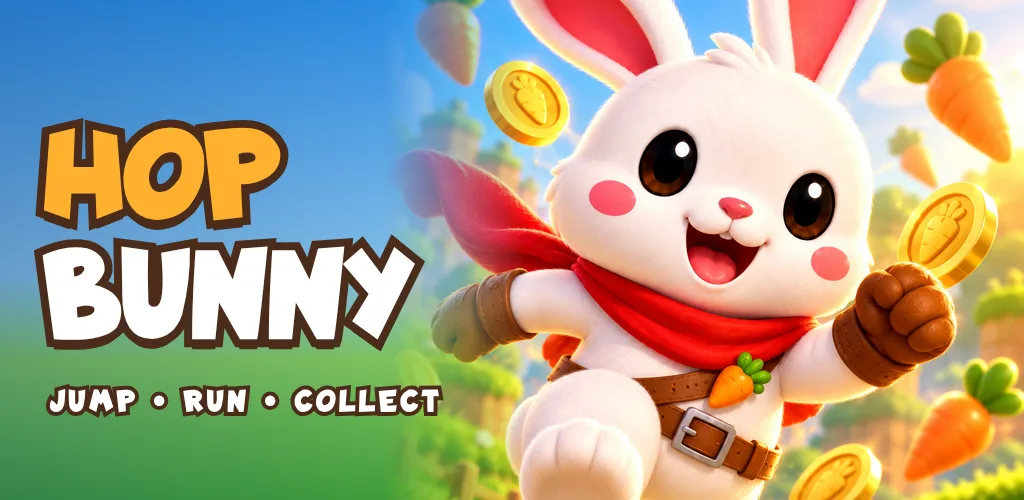

Hop Bunny Slide is the next adventure for Hopi, the bunny from our first game. It is currently in closed testing on Google Play, and we wanted to share how it came together — the ideas we kept, the ones we threw away, and what our first testers taught us.
Why a sled?
When we started planning a second Hopi game, we did not want a copy of the first one. Hop Bunny is about precise jumps on flat ground. For the sequel we wanted speed, curves and the feeling of flying down a hill. A sled gave us all three, and it opened the door to a very "Hopi" idea: what if the sleds themselves were made of fruit and vegetables?
 Hop Bunny is free on Google Play40 levels, 5 worlds, endless fun. Jump in today!
Play free
A garage full of fruit and vegetables
Hopi can ride five different sleds: a cabbage, a carrot, a pumpkin, a watermelon and a royal pineapple. Each one has its own personality — the watermelon sled, for example, has a beach theme with a windshield, float pods and a surf fin.
Every sled can be upgraded from level 1 to level 10, and it visibly changes as it grows. We designed four stages for each sled, and each stage keeps the parts of the previous one, so a fully upgraded sled tells the story of everything you invested in it. The garage marks levels 1–5 in green, 6–9 in silver and level 10 in gold.
Crashes that matter (but never stop the fun)
One of our early design questions was: what should happen when you crash? In many runner games a crash simply ends the run. We wanted crashes to have consequences without being frustrating, so sleds have durability. Each crash damages your sled a little, and the damage is painted onto the sled so you can see it. A damaged sled slows down, but it is never unplayable — you can always reach the finish and repair it later.
Repairs are deliberately generous: the first one is free, and after that you can pay with coins. It is a small system, but it makes choosing the right sled for each level feel meaningful.
Slingshots, a farm and an endless mode
Along the track you will find giant plant slingshots that launch Hopi into the air. Like sleds, slingshots can be upgraded in the garage. Back home, Hopi's Farm grows a little income while you are away, which you can collect when you return.
For players who finish the main levels, there is an Endless mode with changing scenery, day and night cycles and weather, where the goal is simply to beat your best distance.
What our testers taught us
Our first closed test was humbling in the best way. Testers loved the sleds and the speed — and then finished every level in about half an hour. That told us two things: the core idea was fun, and the game needed much more depth before launch.
So we rebalanced. Levels became longer, rewards were scaled so that progress feels steady instead of instant, and strong boosts like rockets were made a little weaker so that skill matters more. We also built a small simulation of the in-game economy to check that a player can actually reach the later levels at a comfortable pace, rather than guessing.
How we build
Tugrion is a small, independent studio, and we use modern tools to punch above our weight. Hop Bunny Slide is built in Unity. We sketch ideas and reference art with AI image tools, turn chosen designs into 3D models, and then do the fitting, tuning and testing ourselves — over and over — until each piece feels right in the game. The tools speed things up, but the decisions about what is fun are always ours.
What's next
Right now we are focused on polish: brighter colors, cleaner menus and more varied levels. We are also exploring a way to race against friends in the future. When Hop Bunny Slide is ready for everyone, we will announce it here and on our social channels.
Want to be the first to know? Follow us on Instagram, TikTok or X.